
Their “Junk DNA” Might Be an Important Factor in Their Survival in our Changing Ocean
Towering underwater “forests” of golden-brown fronds, sometimes over 100 feet tall, that shelter fish, otters, and countless other marine creatures along coastlines from Alaska to New Zealand. For decades, scientists have treated giant kelp (Macrocystis pyrifera) as a single global species – one genetic family spread across two hemispheres and thousands of miles of open ocean.
A new study with Cawthorn Institute, Seqeunch, Nature Metrics and KFF, published in Molecular Ecology says: not so fast.
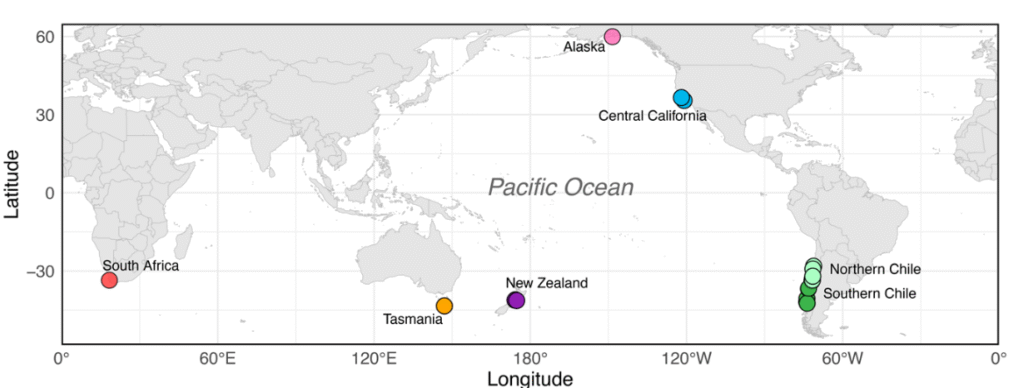
By sequencing the DNA of kelp collected from Alaska, Central California, Chile, New Zealand, Tasmania, and South Africa, a team of researchers has found that giant kelp populations around the Pacific are far more genetically distinct from one another than expected – and that the reasons why involve everything from ancient ocean-spanning splits to weird, repetitive stretches of DNA that seem to hold genetic diversity.
Here’s what they found, and why it’s important.
Kelp forests are pretty, and a pretty big deal
Before getting into the genetics, it’s worth remembering why anyone cares about kelp DNA in the first place. Kelp forests support massive amounts of biodiversity, providing nursery grounds for many species, improve water quality and protect coastlines from wave damage. They’re also currently in trouble – ocean warming, overfishing and events like marine heatwaves have caused kelp forests to shrink or vanish in many parts of the world.
Genetic diversity is what gives a species its ability to adapt to change. A population with lots of genetic variety has more raw material to work with when conditions shift – some individuals are more likely to carry traits that help them survive a heatwave, for instance. So understanding how much genetic diversity kelp actually has, and where it’s hiding, is directly useful for conservation and for kelp farming efforts.
Finding #1: California and the South Pacific kelp are practically strangers
The researchers grouped the kelp they sampled into five genetic populations: Central California, Northern Chile, Southern Chile, New Zealand, and Tasmania (Alaska and South Africa were also sampled but only one usable individual came from each, so they couldn’t be fully analyzed).
The big finding: kelp in Central California and kelp in the South Pacific (Chile, New Zealand, Tasmania) are genetically very different from each other, and there’s almost no evidence of “gene flow” between them – meaning essentially no interbreeding or shared genetic material crossing the equator in either direction for roughly the last 100,000 years.
That’s a long time for two branches of the same “species” to be isolated from one another. The researchers argue this level of divergence suggests these two groups may functionally be on their way to becoming separate species, even though they’re still classified as one.
Interestingly, this isn’t just about distance. Even though there’s a huge ocean gap between hemispheres, kelp within the South Pacific, despite also being spread across thousands of miles between Chile, New Zealand, and Tasmania, showed evidence of continuous, even if weak, gene flow connecting them, likely helped along by ocean currents rafting kelp fragments between coastlines. California, on the other hand, appears to be genetically on its own island.
Finding #2: Diversity shows up in different ways in different places
You might assume “more genetic diversity” is simply better, and less is worse. But the study found that California and the South Pacific kelp maintain their diversity through completely different evolutionary strategies.
– Central California kelp shows signs of having gone through a relatively recent population bottleneck – a period where the population shrank significantly, which usually reduces genetic diversity and can leave harmful mutations “trapped” in the population because there isn’t enough genetic shuffling to weed them out.
– South Pacific kelp (particularly in Chile) shows a different pattern: strong signals of natural selection actively favoring certain genes, more rare genetic variants, and – notably – genes related to carbon processing (like photosynthesis and metabolism) that appear to be under positive selection.
In plain terms: California’s kelp may be coasting on genetic diversity left over from its past, while South Pacific kelp appears to be actively being reshaped by natural selection in the present.
Finding #3: “Junk” repetitive DNA might be a hidden reservoir of diversity
This might be the most unexpected part of the study. Every genome contains large stretches of repetitive DNA – sequences that repeat over and over, historically dismissed by scientists as “junk” with no clear function.
The researchers found that in giant kelp, these repetitive regions aren’t junk at all. They act like protected vaults of genetic diversity. Compared to the rest of the genome, these repetitive stretches showed unusually high genetic diversity and were more resistant to being broken up by the usual genetic reshuffling (recombination) that happens over generations.
This effect was even more pronounced in the South Pacific kelp populations, where these repetitive regions were larger and more often shared across different locations. The researchers suggest that these regions may be acting as long-term storage for genetic variation – including alleles (gene variants) that aren’t currently useful but could become valuable if conditions change, the same way you might keep old tools in storage that only turn out to be useful again years later.
The bigger picture
This study is part of a broader shift in how biologists think about genetic diversity – not just as a single number to maximize, but as something shaped by multiple, sometimes competing evolutionary forces: population history, natural selection, and structural quirks of the genome itself, like repetitive sequences. The researchers describe giant kelp as sitting in the “grey zone” of speciation — not fully split into separate species, but no longer quite the single, uniform species we once assumed either.
—
*This post is a plain-language summary of: Giles, E.C., Zaiko, A., Hampton, H.G., et al. (2026). “Demography and Localized Reservoirs of Diversity Underlie Global Divergence in the Giant Kelp Macrocystis pyrifera.” Molecular Ecology, 35:e70481.*


